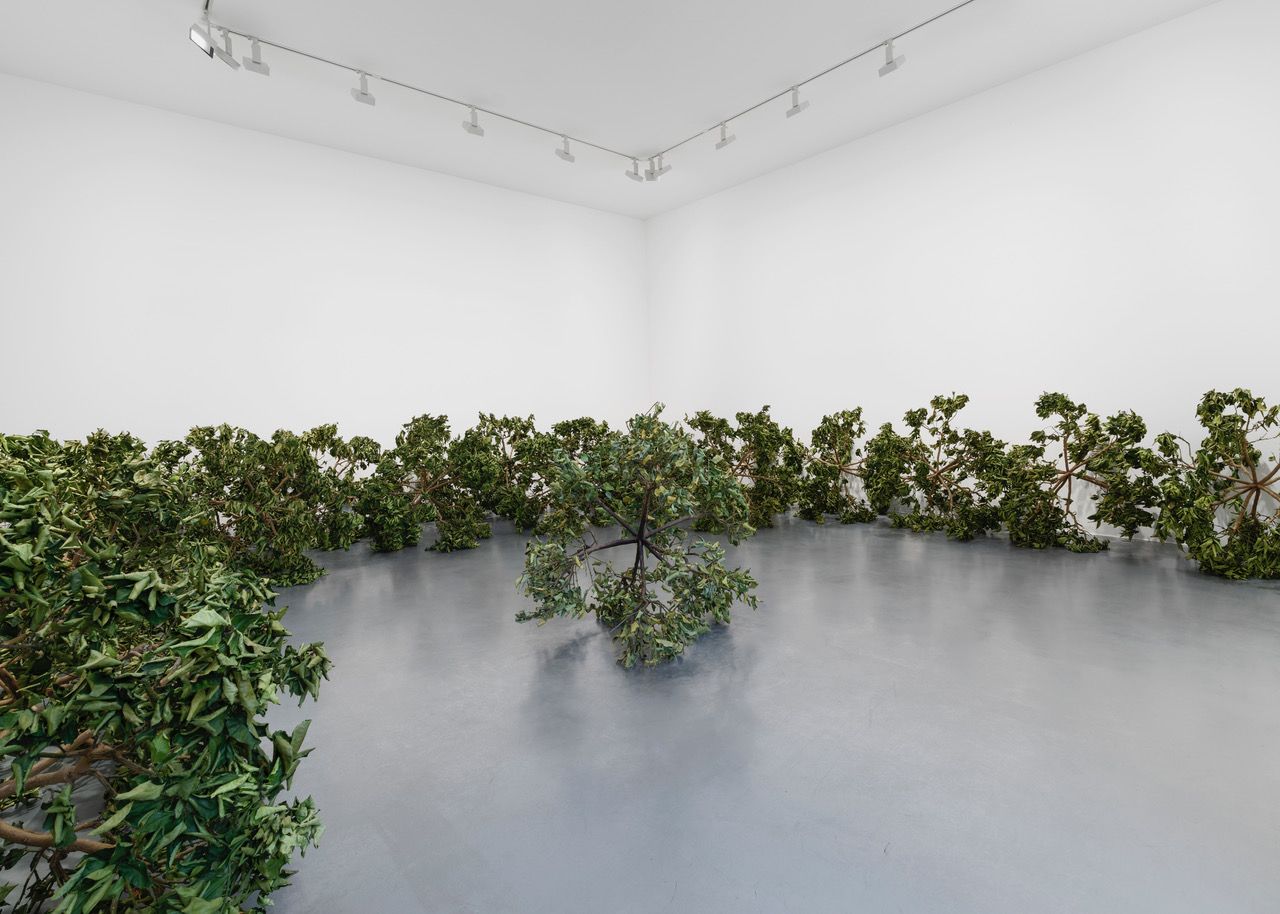
Perrotin is pleased to present Live again, an exhibition exploring Paola Pivi's unique ability to transform wonder into a potent tool for political and spiritual reflection. Pivi debuts a new series of work, New life, which includes an installation of fifty stars of tree branches, composed from lemon trees alongside one bronze composition. For the exhibition, the artist used lemon trees used to create the artworks, which have been cut with care and attention so that the roots can regrow into new plants. This exhibition marks Pivi's sixth solo exhibition in Paris and her twelfth exhibition with the gallery.
Paola Pivi is currently presenting the solo exhibition I don’t like it, I love it at the Art Gallery of Western Australia in Perth, on view until April 26. Beginning April 2, several of her works will also appear in Tragicomica, a group exhibition at the MAXXI – National Museum of 21st Century Arts in Rome. In spring 2026, she will be the subject of a major monographic exhibition titled Come check it out. Lies lies lies at the PHI Foundation for Contemporary Art in Montreal.
On May 4, Pivi will also present the special project This Is Life at the Teatro Goldoni, initiated by Karma Culture Brothers in collaboration with Gelitin, Roberto Cuoghi, and Luigi Ontani, on the occasion of the 61st International Art Exhibition of La Biennale di Venezia.



The accompanying essay is by Valentino Catricalà
Paola Pivi: Towards a Politics of Wonder
In a 2015 interview, Paola Pivi responded to a seemingly simple, even naive question from Maurizio Cattelan: “What is art to you?” Pivi replied: “Imagine two flies on a table—one dead, and one flying. What is the difference between the two? The magic of life. That is the only thing which is close to art, or art is close to that thing. It is strictly connected to the wonder of life, and it is conscious. And for you?” This could serve as a manifesto for Paola Pivi’s vision, grounded in wonder, awareness, and the dissolving of the distance between life and death. Yet, this is not wonder as a mere game, idle amusement, or simple estrangement from the everyday. Pivi’s work is an act of consciousness, a political reflection on the world. It is a “punch to the gut” delivered through familiar elements—colourful bears, overturned helicopters, planes rotating on their axes—that initially attract us, only to open an unexpected horizon: a powerful and direct reflection on our daily lives.
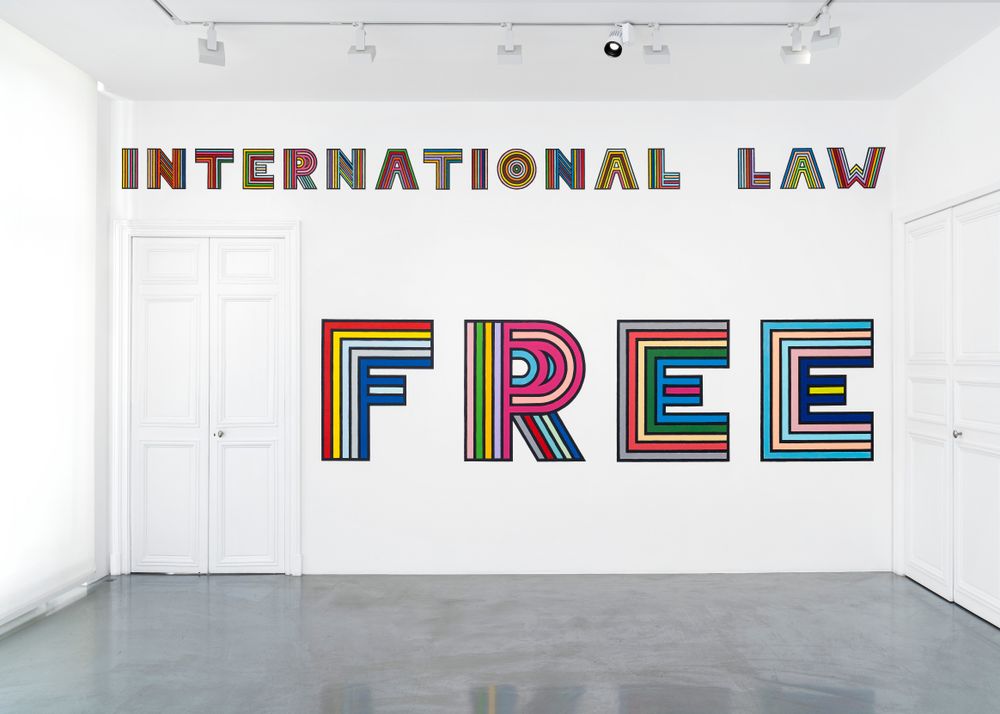
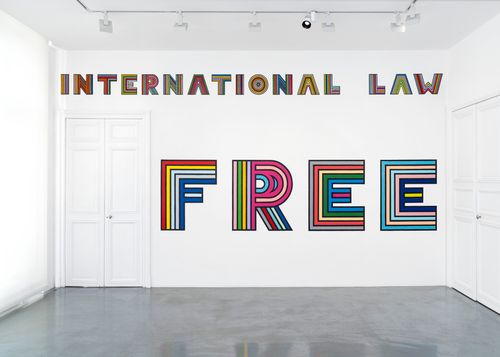
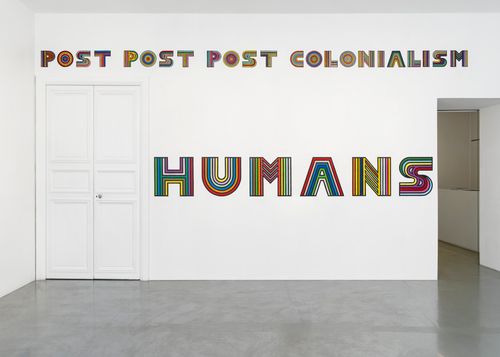
This becomes immediately evident in the first room of this exhibition, which opens with a potent message. The first work the viewer encounters is the text “INTERNATIONAL LAW,” with “FREE” written in large letters directly beneath it. On the opposite wall, as if completing the sentence, we find the word “HUMANS.” The lettering is playful and colourful, hand painted onto the wall, drawing us in with its simplicity; yet, as soon as we read it, we realize the profound and direct nature of the message. It speaks to our present and our future—a “surpassing” that can only be based, as the text suggests, on a “POST POST POST COLONIALISM.”

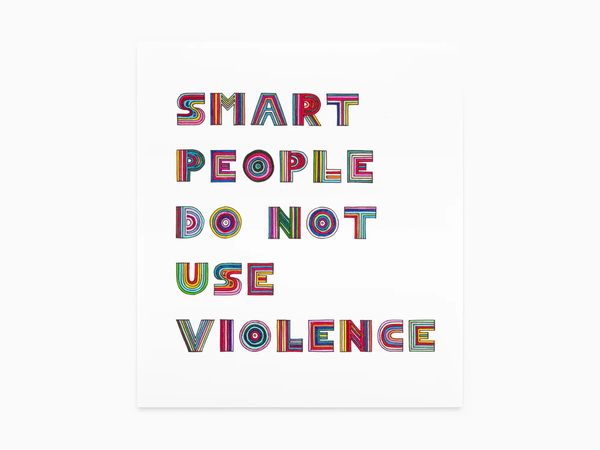
Then comes a reference that is simultaneously spiritual, political and ironic: “God let me hunt.” This refers to the act of hunting, but also to “hunting” in a figurative sense—chasing a dream, a goal, or something one passionately desires for our present and future. Scattered around the walls are luscious silk embroideries depicting more sentences, written with the same iconic typeface created by the artist. The embroideries are premiered for the first time in this show.
In the center of the room sits the 20-meter inflatable ladder, originally presented at the Echigo-Tsumari Triennale in Japan in 2015 and lately on the façade of the Grand Palais in 2025. Here, it is reimagined on a smaller scale, in dialogue with the colours of the wall text and its themes.


The following rooms on the right, feature previously unseen works. A scent wafts from the room the smell of trees, evocative of Sicily. Inside, we find lemon trees, some real and others reproduced in bronze. It is difficult to distinguish between them because both seem to move; both appear real. These trees, however, are like bushes—or rather, upon closer inspection, they are stars. An idea from 1999 realized today in this exhibition at Perrotin: trees becoming stars, becoming a universe. They connect us directly to the deepest part of ourselves—the natural and, once again, the spiritual.c

The bronze trees are masterfully crafted at the Fonderia Artistica De Carli in Turin using innovative techniques that allow for incredibly fine bronze branches that seem to sway in the wind. As bronze mingles with living plants in the same room, the distinction between the real and the artificial dissolves.

Deflated balloons welcome the visitor into the last room of the show, a work that dialogues with the adjacent space filled with sentences as an act of direct political critique—in this case, against the Mafia. Commissioned for a project by Triennale on terrorist attacks in Italy, Pivi exhibits burst balloons held by iron rings. Those balloons are us: they are not only a direct reference to the victims of the Mafia but also a symbol of ourselves, hanging inert in the face of such a painful phenomenon.
Alongside the political act, this same room houses her significant work with pearls, a series begun in the 1990s. Here, we encounter another vital element of the artist’s practice that is often overlooked: the spiritual. Indeed, there is something spiritual in Paola Pivi’s work; as she herself states: “I want to express the spiritual side of creative thought and invention, which is naturally very different from the creative thought of decoration. When my child learns to count, his mind is spiritual, and this counting will allow him to reason about his life in the future.” She continues, “It is ancestral. Primitive.” The pearls represent this spiritual act—one of the most hypnotic and tactile aspects of Pivi’s research. If the polar bears are her “characters,” the pearls represent her most abstract, Zen, and almost obsessive soul. These are not mere decorations but true wall sculptures. Pivi utilizes thousands of artificial pearls (often plastic or plexiglass) strung and fixed onto large canvases or wooden panels. While animals are a constant in Pivi’s work, here the animal is only evoked: the oyster that produces the pearl, the pure object par excellence that emerges from its shell, leaving us with something of cultural, economic, and natural value.
When an intruder enters the shell, the oyster begins to deposit thousands of microscopic layers of nacre around it as a defence. These overlapping layers create the pearl’s characteristic iridescence: light passes through the levels and is reflected back, creating the visual effect known as “luster.” Just as an oyster deposits layer after layer to create a pearl, Pivi accumulates thousands of these small objects to construct a massive work. It is a labour of infinite patience, nearly a meditation—a reflection on the relationship between closed and open systems, and on the parasite or intruder as a force that creates something as special as a pearl.

Surrealism, dreams, irony, playfulness, the subversion of reality—Pivi’s work has been described in many ways. Yet, this exhibition demonstrates something more: how dreams, irony, and the overturning of reality can be acts of both politics and wonder. In an era where many historical nightmares we thought were behind us are returning, Pivi’s work gains increasing importance. Wonder is precisely this: that fraction of a second in which the world “breaks” and ceases to be taken for granted. It is a cognitive short circuit: your senses receive information that your mind does not yet know how to categorize, thereby creating awareness. This is what Paola Pivi does—attracting us with her colours and irony, only to lead us into an experience of the full complexity of the world.

Born in 1971 in Milan, Italy.
Lives and works in Anchorage, USA. Milan, Italy and Toronto, Canada.
Born in Italy in 1971, Paola Pivi’s artistic practice is diverse and enigmatic. Commingling the familiar with the alien, Pivi often works with commonly identifiable objects which are modified to introduce a new scale, material or color, challenging the audience to change their point of view. Animals are often cast as protagonists in Pivi’s world. She draws upon their perceived characteristics and instills them with human mannerisms. In Pivi’s art, Polar bears practice yoga, hang from trapezes, and engage with one another. Sprouting multicolored feathers, the artworks are both life-sized and miniaturized as baby bears. Spanning sculpture, video, photography, performance and installation, Pivi’s practice trespasses perceived limits to make possible what before seemed impossible. Zebras frolic in the arctic, goldfish fly on airplanes, and in her 2012 Public Art Fund installation, a Piper Seneca airplane was lifted on its wingtips and installed to constantly rotate forward.
More about the artist