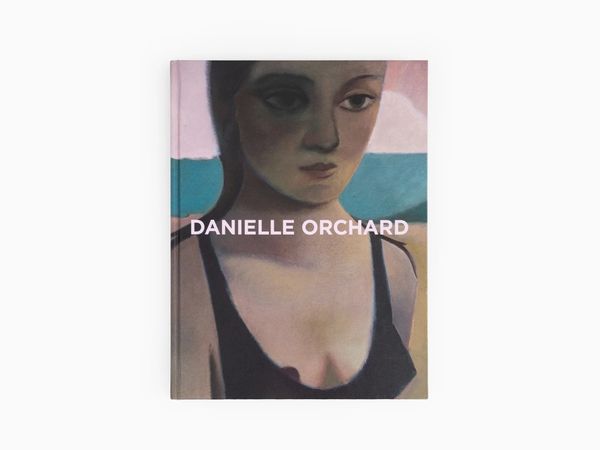
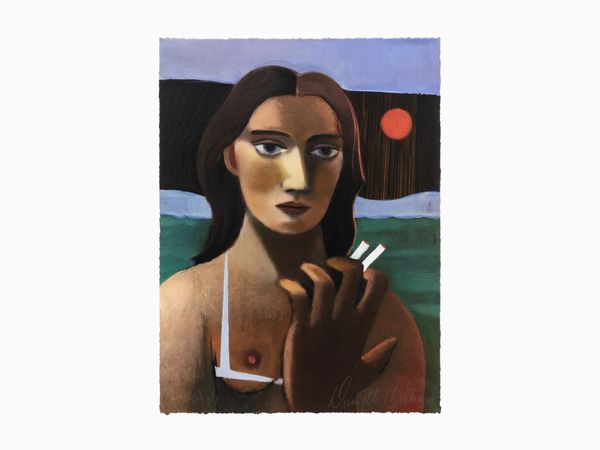
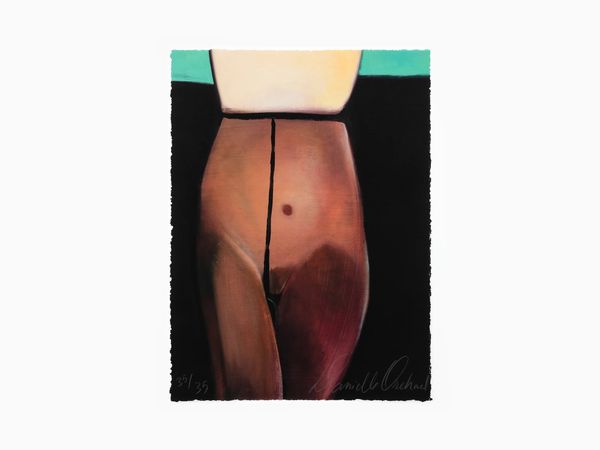
Perrotin is pleased to present Borrowed Chord, Danielle Orchard’s second exhibition in Paris and her seventh with the gallery. The exhibition brings together new works that deepen her engagement with figuration, intimacy, and the history of painting. Borrowing its title from a musical term describing a harmony drawn from a parallel key, the exhibition reflects Orchard’s longstanding practice of working within established pictorial traditions—modernist fragmentation, classical composition, and the reclining figure—while subtly shifting their emotional register.


At first glance, Danielle Orchard’s paintings appear unapologetically intimate, direct, and above all devoted to representing the female figure. Languid nudes recline, bathe, read, or drift through private moments of subdued introspection. Suspended between action and reverie, these bodies inhabit tranquil spaces rendered in a restrained yet luminous palette. The apparent ease of these genteel tableaux and the quiet inwardness of their pictorial worlds invite sustained looking, drawing the viewer into scenes that unfold at the measured tempo of contemplation.
Beneath this surface calm, however, Orchard’s work engages with some of the enduring questions of modern figurative painting: how sensation becomes structure, how feeling assumes form. Orchard’s work does not seek to narrate experience so much as to organize it, integrating the immediacy of subjectivity—through autobiographical motifs like smoking, drinking wine, and motherhood—into the formal coherence of the canvas. In this respect, her paintings participate in an art-historical lineage investigating how modernism’s formal ambitions could coexist with a deep commitment to the visible world.


Orchard’s engagement with the figurative tradition treats the language of modernism not as a set of exhausted forms, but as a living system—capable of generative renewal through sensitivity to form, color, and the enduring possibilities of painting itself. Her figures resist the conventions of display that have historically governed representations of the female body. They are neither psychological portraits in the traditional sense nor abstracted symbols, but presences that emerge through the orchestration of color, line, and surface.
Although her compositions begin with the female form, the true subject of these paintings lies in the relationships among their elements: the rhythm of contours, the tensions of hues, and the subtle equilibrium between enclosure and openness. As in the strongest modern traditions, the figure is constructed through color and contour rather than through anatomical precision; it is felt before it is described.

To this end, color functions as a primary structural device. Orchard’s chromatic choices—often restrained, muted, and subtly luminous—are never merely atmospheric or expressive in the conventional sense. Instead, they establish the internal logic of the composition; color isn’t merely descriptive of form and space, but generative. It is a compositional intelligence that echoes the formal experiments of modernism. In Orchard’s paintings one feels the presence of Henri Matisse’s decorative fields, Pierre Bonnard’s flickering interiors, and the chromatic daring of the Fauves.
Orchard’s confident palette possesses an emotional precision that trusts the chromatic relationships to define the connection of one object to another. A limb may be defined less by contourthan by the way one color presses against a plane of another, or by the manner in which a muted hue stabilizes and orders the surrounding composition. Under Orchard’s brush, color becomes the means by which form and feeling are held in equilibrium.
Line too possesses its own sensuous quality in Orchard’s compositions, operating not so much as boundary but as the instigator of movement. Floors and tabletops tilt upward, walls compress or dissolve, and windows open onto improbable expanses of color—distortions that echo the spatial experiments of Paul Cézanne and of Matisse, as well as Cubist geometry. Orchard’s figures and objects do not exist in isolation but are continuously defined and negotiated by the surrounding space and by their relationship to each other, with placement and contour governed by their compositional necessity. This spatial strategy intensifies the viewer’s engagement with the painting as an object—a holistic arrangement of forms and colors—while preserving the intimacy of a subject matter grounded in lived observation.


What ultimately stands as the most striking aspect of Orchard’s paintings is their quiet authority. They do not demand attention through spectacle or narrative drama. Rather, they sustain it through their taut formal coherence. Each work achieves a sense of inevitability, as though no element could be altered without disturbing the whole. This quality, so difficult to attain, arises from the artist’s commitment to the internal necessities of painting—to the belief that a work must discover its form from within rather than impose it from without.

In this way, Orchard extends the modern project into the present tense, her complex compositions demonstrating that painting remains capable of addressing the deepest human concerns—intimacy, solitude, desire—through the disciplined organization of visual means. In this way, Orchard yields a body of work of remarkable emotional subtlety, and offers a space of reflection where the intuitively felt and carefully calibrated find equilibrium. It is this rare balance, quietly achieved and rigorously sustained, that gives Orchard’s work its lasting resonance.
Written by Max Weintraub, PhD - President & CEO, Allentown Art Museum, Allentown, Pennsylvania, United States


Born in 1985 in Michigan City, IN, USA.
Lives and works in Pelham, MA, USA.
Nodding to the great painters of the modern era including Picasso and Matisse, Orchard’s paintings often reference their styles and subject by portraying female nudes in a more abstract manner; the figures are portrayed in multi-perspectival Analytic Cubist style or abbreviated otherwise into solid contours and saturated colors. As she tackles depiction plane by plane, or each abstract part that she sculpts with thick impasto, Orchard is exploring the female corporeal representation. While the concept of female nude finds itself deeply ingrained in art history as a muse and more recently being established as a subject of study, Orchard adds depth by infusing her own experiences as a female artist, having trained, posed, and even taught in life drawing classes.
In narratives ranging from art historical tropes to contemporary leisure activities, the viewers can expect to find scenes of familiarity in Orchard’s work. By using popular motifs, Orchard eliminates the viewers’ guesswork in discerning the subject, directing their attention to her mode of expression instead. As the backgrounds or accompanying objects echo the body language of the women, depicted with muted emotions, the artist invites the viewers to empathize and contemplate on the interiority of the models.
More about the artist